
FOSDEM 2026 Reflections
Last weekend, I attended FOSDEM, the largest Open Source conference in Europe. The last time that I attended was exactly a decade ago, and I had forgotten what it was really about.
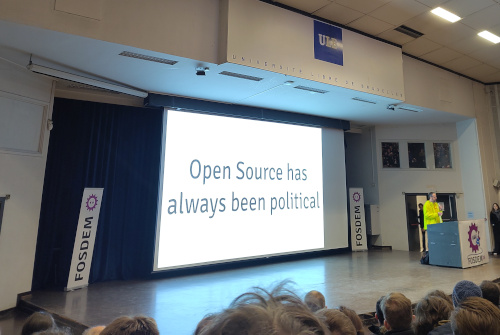
But this became instantly obvious when (nearly) the first slide during the Opening Remarks shouted loudly: "Open Source has always been political". The emotional introduction instantly brought home what Open Source is really about: Activism to break the chains of "big tech". Although big tech wasn't so big when they started the conference over 25 years ago, it is now more required than ever.
As I remembered that it can be really hard to get into the rooms where talks are held — FOSDEM can be really busy — I had made a plan to divide my two days up in roughly four blocks to follow talks in the same room. I also made sure I showed up a talk (or two before), to have a better chance of having a seat in the talks I wanted to attend.
I spend most of Saturday following talks in the Geospatial and Legal & Policy tracks. Although Geospatial, mostly through OpenStreetMap, is my fun open data involvement, the Legal & Policy tracks were good to see.
In From Policy To Practice; Open Source in The Dutch Government, I learned from Gina Plat how the (old and new) Dutch governments are now pushing ahead with Open Source. With the more volatile situation in the USA, where constant threats of tariffs and other economic measure, they seem to now have understood, that it is vital to build up their own stacks. Although there have been policy and plans before, there is now also funding available to reduce the liability on US big tech stacks and software. It's not perfect, but there is certainly progress.
After more geo fun in the afternoon, I attended Neil Brown's "Online Safety" laws: reflections for FOSS projects (video). Although I am familiar with the topic, and have written about this before to my MP, it was good to see Neil explain how this affects open source projects specifically. The main take-away here was that although you can follow the law(s) to the latter, it is likely going to be more important to check what risk there actually is for users, and for the project itself, when the regulator comes knocking on the door.
Talks on regulations, mostly in the EU form, is what my piqued my interest next, and I spend most of my Sunday morning in the Open Source & EU Policy track.
I arrived early enough to catch the Digital Omnibus: is the EU's tech simplification a Risk or Opportunity from Open Source. How EU Policy is created is often complicated. This talk critically explored the challenges that policymakers have to make the regulatory burden on EU projects and products lighter. At the same time, regulation should not get in the way of innovation and competitiveness, but also not be so light that the general protections towards user privacy and control are watered down too far.
I was mainly aiming to see "The Fediverse and the EU's Digital Service Act". Jordan Maris moderated this panel discussion, with Sandra Barthel, Alexandra Geese (MEP for the Greens/EFA group), and Felix Hlatky (executive director of Mastodon GmbH), answering questions. The whole discussion was interesting, my main takeaways were the explanations by Alexandra on the DSA.
The provisions under the DSA are frequently derided by the American tech bros and their government allies as "censorship". Alexandra eloquently argued that the provisions in the DSA are explicitly meant to do the opposite. The DSA requires large operators to explain what their algorithms do, and how they work, to (try to) prevent the doom-spiral towards hate speech and othering. These algorithms have been designed to keep users engaged so that they see more advertisements. And the best way to keep users on your platform is to make them feel angry about something — usually vulnerable groups of people.
While listening to the panel, the though occurred to me that the approach by the EU is very different from the approach across the ocean. Where there the mentality is "work fast and break things", with no regulation to protect people's rights succinctly, in the EU the approach is strong regulation to prevent harm.
But that does require that the provisions are properly enforced, with enough resources, and sometimes with enough political will to not kowtow to the Americans with their tantrums. I suspect that we will see more of these tantrums in a short while, now that the EU is more keen to show its fangs as well.
On this side of the pond all is not well either. The UK's Online Safety Act is already a sad state of affairs, especially now there are rumours that they are considering banning age gating VPNs as well. But Age Verification as a measure to "save the children" is popping up in many jurisdictions. Age Verification and Assurance are antithetical to the open nature of the Web and free expression, and will not work regardless.
Where the focus now mainly is on websites themselves, there is a distinct possibility that regulators will want to enforce age on service level (app stores/package managers), on browser level, and on operating system level. These all conflict with open source variants (F-droid, Firefox, Linux), unless you withdraw the freedom that users have on what to run on their devices.
Nobody has any idea how a wide roll-out of Age Verification and Assurance will work out. It's like going straight to a release without beta testing. Preventing the broadening of Age Verification and Assurance is where the next fight for the open web and freedom of expression now must be.
We don't have the luxury of sitting on our hands, and as the opening slides of FOSDEM indicated that "Open Source has always been political", the closing remarks were equally pungent: We can't afford to not be politically active, and that's why we must engage with politicians. FOSDEM has fanned the flames in me for doing more again. Stay tuned!
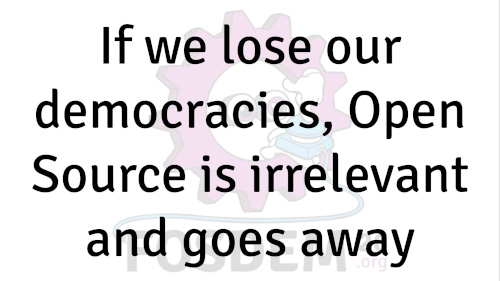
And remember: "If we lose our democracies, Open Source is irrelevant and goes away".

Likes
❤️ adrienandrem
❤️ Alison Meeks
❤️ Athanasius
❤️ DRiOscar
❤️ Exit Code 1
❤️ flacs @🗼
❤️ Ilya Zverev
❤️ Jaime Herazo
❤️ Leonardo
❤️ Linus Gasser
❤️ Louis
❤️ Matt Ellery
❤️ Max Westen
❤️ Moray
❤️ sam
❤️ Semitones
❤️ SKC 🏳️🌈
❤️ Timo Tijhof
❤️ tofe
❤️ Vee
❤️ Wouter


Life Line
Specify street/place names to addresses
Specify bicycle parking capacities
Specify bicycle parking fees
Specify bicycle parking access
Specify whether crosswalks have tactile paving
Specify width of opening
Specify whether pitches are lit
Specify pitch surfaces
Specify whether pedestrian crossings have markings
Specify step counts
Survey tactile paving on steps
Specify whether steps have a ramp
Specify which way leads up for steps
Specify whether pedestrian crossings have islands
Specify whether pedestrian crossings have traffic signals
Determine roads lane count
Specify whether roads have lane markings
Survey if places still exist
Specify whether roads have sidewalks
Survey postbox collection times
Survey opening hours
Determine whether ATM allows depositing cash
Specify bicycle parkings covers
Specify whether crosswalks have tactile paving
Specify whether traffic signals have tactile indications that it's safe to cross
Shortlink
This article has a short URL available: https://drck.me/fosdem26-k3y