
Weather from the Norwegians, sunset and sunrise

I have recently acquired a Raspberry PI and as a hacking project I am using it as status screen in the living room. As part of this, it has a weather widget.
I use the weather data from http://yr.no ("the Norwegians") as they provide free weather data for the whole world. For each location, there is a nice XML file with the weather forecast.
The XML file has a forecast for several periods. See for example the first upcoming one:
<?xml version="1.0" encoding="utf-8"?>
<weatherdata>
  …
  <forecast>
        <tabular>
          <time from="2012-12-21T12:00:00" to="2012-12-21T13:00:00">
                <symbol number="1" name="Fair" var="01d" />
                <precipitation value="0" />
                <windDirection deg="253.3" code="WSW" name="West-southwest" />
                <windSpeed mps="4.8" name="Gentle breeze" />
                <temperature unit="celsius" value="7" />
                <pressure unit="hPa" value="1009.8" />
          </time>
This shows among others, the period (December 21st, 12:00 to 13:00), the symbol to use (number="1"), the expected precipitation and temperature. There is a description of what the symbols mean. The page is in Norwegian, but that's all right, as I can actually read that.
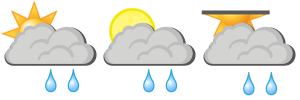
For most of the symbols there is both a day and a night variant of the symbol. And in some cases, there is also a "mørketid" variant - the period in which the sun never comes over the horizon.
In each XML file, the coordinates of the location for which the forecast is are also present:
<?xml version="1.0" encoding="utf-8"?>
<weatherdata>
  <location>
        <name>London</name>
        <type>Capital</type>
        <country>United Kingdom</country>
        <timezone id="Europe/London" utcoffsetMinutes="0" />
        <location altitude="21" latitude="51.50853" longitude="-0.12574" geobase="geonames" geobaseid="2643743" />
  </location>
The location information comes from http://geonames.org, which handily also includes the Olson timezone ID for the location. The timezone ID combined with the time, the latitude and the longitude are enough to calculate sunrise and sunset times with PHP's date_sun_info() function.
For example, to find out the sunset and sunrise for today in London (Europe/London, 51.50833°N, 0.12574°W):
<?php
$result = date_sun_info( time(), 51.50853, -0.12574 );
print_r( $result );
?>
This returns the following array:
Array
(
        [sunrise] => 1356077046
        [sunset] => 1356105238
        [transit] => 1356091142
        [civil_twilight_begin] => 1356074637
        [civil_twilight_end] => 1356107647
        [nautical_twilight_begin] => 1356072046
        [nautical_twilight_end] => 1356110239
        [astronomical_twilight_begin] => 1356069597
        [astronomical_twilight_end] => 1356112687
)
Each value is a Unix timestamp. To display when the Sun rises and sets:
<?php
$result = date_sun_info( time(), 51.50853, -0.12574 );
echo 'Sunrise: ', date( 'H:i', $result['sunrise'] ), ", ";
echo 'Sunset: ', date( 'H:i', $result['sunset'] ), "\n";
?>
Which shows (for today): Sunrise: 08:04, Sunset: 15:53. The transit value is the time when the Sun is at its highest point, and the different twilight_begin/twilight_end values represent different start and end times of the three different forms of twilight. From the above information, it is also trivial to calculate the length of day: echo $result['sunset'] -
$result['sunrise']); (or today in London: 28192 seconds, which is 7h49m52s).
Near the summer and winter solstices there are regions on Earth where the Sun never rises (the afore mentioned "mørketid") or when the Sun never sets. If we take for example Kirkenes in Northern Norway (69.72°N, 30.04°E), we can calculate all the different values with:
<?php
date_default_timezone_set( 'Europe/Oslo' );
$result = date_sun_info( time(), 69.72, 30.04 );
foreach ( $result as $key => $value )
{
        if ( gettype( $value ) == 'boolean' ) {
                echo $key, ': always ', $value ? 'above' : 'below', "\n";
        } else {
                echo $key, ': ', date( 'H:i', $value ), "\n";
        }
}
?>
Which shows:
sunrise: always below
sunset: always below
transit: 10:58
civil_twilight_begin: 08:48
civil_twilight_end: 13:07
nautical_twilight_begin: 07:03
nautical_twilight_end: 14:53
astronomical_twilight_begin: 05:44
astronomical_twilight_end: 16:11
Indicating that the Sun never rises. During summer (July 22nd, 13:45 CEST), it shows for Kirkenes:
sunrise: always above
sunset: always above
transit: 12:06
civil_twilight_begin: always above
civil_twilight_end: always above
nautical_twilight_begin: always above
nautical_twilight_end: always above
astronomical_twilight_begin: always above
astronomical_twilight_end: always above
Which indicates that the Sun is always above the horizon.
It is important to use the correct timezone in your script, otherwise you get weird results:
<?php
// Timezone for London, location for Los Angeles
date_default_timezone_set( 'Europe/London' );
$result = date_sun_info( time(), 34.0522, -118.2437 );
echo 'Sunrise: ', date( 'H:i', $result['sunrise'] ), ", ";
echo 'Transit: ', date( 'H:i', $result['transit'] ), ", ";
echo 'Sunset: ', date( 'H:i', $result['sunset'] ), "\n";
?>
Which then shows:
Sunrise: 14:55, Transit: 19:51, Sunset: 00:48
Which is clearly incorrect.
Now we have figured out whether it's day, night or "mørketid" we can show the correct symbol. With "Partly Cloudy" (symbol $nr = 5) we select the symbol as follows:
if ( $result['sunrise'] === false || $result['sunset'] === false )
{
        $symbol = sprintf( "%02dm", $nr );
}
else if ( time() > $result['sunrise'] && time() < $result['sunset'] ) )
{
        $symbol = sprintf( "%02dd", $nr );
}
else
{
        $symbol = sprintf( "%02dn", $nr );
}
Some last notes
If I would have paid more attention, I would have seen in the XML file:
<sun rise="2012-12-21T08:03:58" set="2012-12-21T15:53:39"/>
which means I wouldn't have had to calculate the sunrise and sunset.
I would also have seen the var="mf/01n.26" part of:
<time from="2012-12-21T16:00:00" to="2012-12-21T17:00:00">
  <symbol number="1" name="Fair" var="mf/01n.26" />
which means I wouldn't have to do the ugly trick to create the correct symbol in the first place… Of course, this article wouldn't have been as nearly as interesting then.
Happy Southern Solstice!

Comments
Hi
Nice article.
I actually stumbled upon yr.no the other day after months of searching for the type of data they provide. Unfortunately I can't read Norwegian but Google translate helped me out.
Could you please explain the following to me. What is the meaning of this attributes in the location part: geobaseid="2643743"
Thanks Steven
@Steven: The geobaseid refers to the ID for entries in the GeoNames database. You can download those files at http://download.geonames.org/export/dump/ and the ID is the first column in each of the country files.


Life Line
Only test with 8.2 and later on master with Xdebug CI
Merge branch 'xdebug_3_5'
Remove expliciy path from Xdebug CI
If you're wondering why the @Xdebug issue tracker is unavailable, I can conclusively say that it's another bout of LLM scrapers.
I walked 1.3km in 14m45s
Created 18 benches and a grave; Updated 3 benches, a tree, and a waste_basket
I walked 6.1km in 3h9m07s
Updated a vacant business
Updated a bar
I walked 1.6km in 18m00s
Updated a pub
I walked 3.4km in 54m56s
I walked 1.9km in 23m48s
Updated a pub
I walked 3.4km in 22m41s
Updated a restaurant
I walked 7.2km in 3h16m35s
I walked 9.5km in 2h0m35s
Ribbit!
I heard this little one way before I could see it. It is so well camouflaged!
#photography #NaturePhotography #frogs #green

Created 3 entrances, 3 emergency entrances, and a main entrance; Confirmed a childcare
I walked 6.8km in 1h16m53s
Updated a restaurant
I walked 10.0km in 1h43m36s
I had a good run at Polderprikker today!
#Polderprikker nummer 84 • 4810/5000
🟦1000 🟦1000 🟨879 🟩931 🟦1000
https://polderprikker.nl/I'm looking forward to attending the State of the Map OpenStreetMap conference this coming week in Paris.
Will I see you there?
Shortlink
This article has a short URL available: https://drck.me/sun-9nn