
Hunting for Postboxes (part 1)
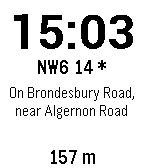
The new year brings new hobby projects! In this year, I am going to try to photograph as many UK postboxes as I can. For this I am going to build some apps and overview maps, but I will write more about those later. A teaser for a future post is here to the left ;-).
The first thing that I want my application(s) to do is to give a description of where a postbox is located and this post is the tale of how I went about just doing that.
As my data source, I am using an OpenStreetMap extract for the London region. I import that through my "Import OSM data into MongoDB" script that I wrote about in an earlier article. The script is available on GitHub as part of the 3angle repository. The latest version is at https://raw.github.com/derickr/3angle/master/import-data.php and it also requires https://raw.github.com/derickr/3angle/master/classes.php for some GeoJSON helper classes and https://raw.github.com/derickr/3angle/master/config.php where you can set the database name and collection name (in my case, demo and poiConcat).
My goal is to get from a longitude/latitude pair to the closest postbox's reference number (EC2 201), a description like (On Paul Street, on the
corner with Epworth Street), and a direction and distance (East, 86m).
The first thing I do is to look-up the closest postbox. I can very easily do that with the following aggrgation query in MongoDB:
<?php
$m = new MongoClient( 'mongodb://localhost' );
$d = $m->selectDb( 'demo' );
$c = $d->selectCollection( 'poiConcat' );

$center = new GeoJSONPoint( (float) $_GET['lon'], (float) $_GET['lat'] );

$res = $c->aggregate( array(
        '$geoNear' => array(
                'near' => $center->getGeoJson(),
                'distanceField' => 'distance',
                'distanceMultiplier' => 1,
                'maxDistance' => 5000,
                'spherical' => true,
                'query' => array( TAGS => 'amenity=post_box' ),
                'limit' => 1,
        )
) );
I am using the aggregation framework instead of a normal query because the aggregation framework also can return the distance to the found object. The above returns $res, and our first result is located in $res['result'][0], which looks like:
array(
        '_id' => 'n905143645',
        'l' => array(
                'type' => 'Point',
                'coordinates' => array( -0.1960, 51.5376 ),
        ),
        'm' => array(
                'v' => 5,
                'cs' => 14576087,
                'uid' => 37137,
                'ts' => 1357659884,
        ),
        'ts' => array(
                0 => 'amenity=post_box',
                1 => 'operator=Royal Mail',
                2 => 'ref=NW6 14',
        ),
        'ty' => 1,
        'distance' => 162.15002059040299,
),
So postbox NW6 14 is 162.15 meters away from -0.1979, 51.5385 at -0.1960, 51.5376, as you can see in this image:

To find a description of where the postbox is, we first find the closest road:
$r = $res['result'][0];
$query = [
        LOC => [
                '$near' => $r['l']
        ],
        TAGS => new     MongoRegex(
                '/^highway=(trunk|pedestrian|service|primary|secondary|tertiary|residential|unclassified)/'
        )
];
$road = $c->findOne( $query );
highway is an OpenStreetMap tag that is also used for footpaths, service roads and alleys. These generally don't have names, so with the regular expression we restrict the query to only return "normal" roads. After executing this query, $road now contains:
array (
        '_id' => 'w4442243',
        'ty' => 2,
        'l' => array (
                'type' => 'LineString',
                'coordinates' => array (
                        array (
                                -0.2046823,
                                51.5346008,
                        ),
                        …
                        array (
                                -0.1940129,
                                51.5384693,
                        ),
                ),
        ),
        'ts' => array (
                'hgv=destination',
                'highway=secondary',
                'lit=yes',
                'name=Brondesbury Road',
                'note=Signed as maxweight 7.5T for goods vehicles except for access, so have tagged as hgv=destination',
                'ref=B451',
                'sidewalk=both',
                'source:ref=OS OpenData StreetView',
        ),
        'm' => array (
                'v' => 15,
                'cs' => 18802367,
                'uid' => 37137,
                'ts' => 1384017096,
        ),
)
As an image this looks like:
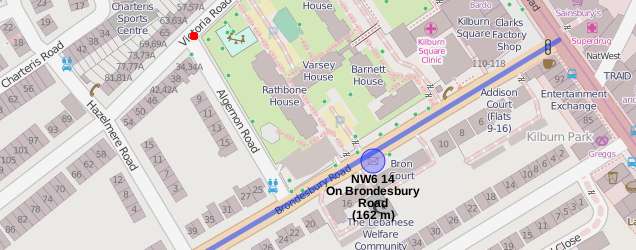
We are interested only in the name (name=Brondesbury Road) and the geometry (l). Right now, we can already assemble the description NW6
14, on Brondesbury Road. But we also want to know the closest cross road, which we can find by finding all roads that intersect with our geometry (in l) by running the following query:
$q = $c->find( [
        'l' => [
                '$geoIntersects' => [ '$geometry' => $road['l'] ]
        ],
        'ts' => new MongoRegex(
                '/^highway=(trunk|pedestrian|service|primary|secondary|tertiary|residential|unclassified)/'
        ),
        '_id' => [ '$ne' => $road['_id'] ],
] );
This returns nineteen roads. An extract looks like:
array(19) {
        'w4211713' => array(5) {
                '_id' => string(8) "w4211713"
                'ty' => int(2)
                'l' => array(2) {
                        'type' => string(10) "LineString"
                        'coordinates' => array(22) { ... }
                }
                'ts' =>
                array(4) {
                        [0] => string(19) "highway=residential"
                        [1] => string(15) "maxspeed=20 mph"
                        [2] => string(23) "name=Brondesbury Villas"
                        [3] => string(13) "sidewalk=both"
                }
                …
        }
        'w245650577' =>
        array(5) {
                '_id' => string(10) "w245650577"
                'ty' => int(2)
                'l' => array(2) {
                        'type' => string(10) "LineString"
                        'coordinates' => array(5) { ... }
                }
                'ts' =>
                array(6) {
                        [0] => string(15) "highway=primary"
                        [1] => string(7) "lit=yes"
                        [2] => string(15) "maxspeed=30 mph"
                        [3] => string(22) "name=Kilburn High Road"
                        [4] => string(6) "ref=A5"
                        [5] => string(13) "sidewalk=both"
                }
                …
        }
}
As an image this looks like:
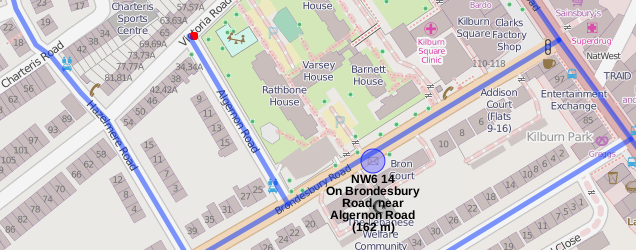
We are only interested in the roads that have a name and have a different name than the road we have run the intersection query for. In some cases, OpenStreetMap splits up a road in more than one segment carrying the same name. We discard both those in a loop and are then left with an array of intersecting road IDs in the $intersectingWays variable:
$intersectingWays = array();
foreach ( $q as $crossRoad )
{
        $crossTags = Functions::split_tags( $crossRoad[TAGS] );
        if ( !in_array( "name={$roadName}", $crossRoad ) && array_key_exists( 'name', $crossTags ) )
        {
                $intersectingWays[] = $crossRoad['_id'];
        }
}
With these IDs, we then search for the closest road(s) to the initially found postbox location:
$res = $c->aggregate( array(
        '$geoNear' => array(
                'near' => $r['l'],
                'distanceField' => 'distance',
                'distanceMultiplier' => 1,
                'maxDistance' => 5000,
                'spherical' => true,
                'query' => [
                        '_id' => [ '$in' => $intersectingWays ],
                        'ts' => [ '$ne' => "name={$roadName}" ]
                ],
                'limit' => 1,
        )
) );
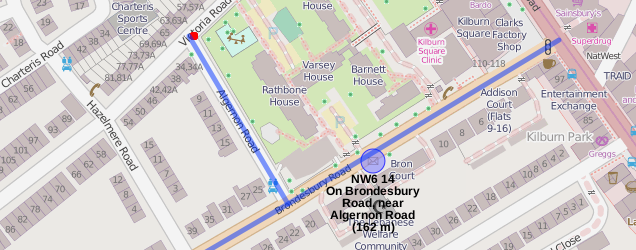
Again, the result in $res is in a similar format as before, so I won't repeat that. We use the aggrgation framework again so that we also get the distance of this intersecting road to the originally found postbox location. Depending on the distance to the intersecting road, we either use on the
corner of <roadname> (less thatn 25m) or near <roadname> if it's further away than 25m. For our example postbox, that makes NW6 14, on Brondesbury
Road, near Algernon Road which is illustrated by this image:
The full code for this example can be found at https://github.com/derickr/3angle/tree/master/maps-postbox and you see it in action (for London) at: http://maps.derickrethans.nl/?l=postbox,lat=51.5&lon=-0.128&zoom=17

Comments
Matthew Somerville's site provides a map of postboxes which I believe includes those that are NOT in OpenStreetMap. My understanding is that he is using the data from a FOI request
http://dracos.co.uk/made/nearest-postbox/
https://www.whatdotheyknow.com/request/location_of_every_post_box_that#incoming-1164
https://www.whatdotheyknow.com/request/royal_mail_post_box_types_collec#incoming-31588
In regards to my previous comment, the following appears to include grid reference locations (that could be converted to lat&lon):
https://www.whatdotheyknow.com/request/postbox_data_in_central_collecti_2
If you add these to your app then you could also use this to find postboxes not yet added to OSM :-)
I do something similar in India. Check http://openbangalore.org/postbox/
I am in the process of uploading the data to OpenStreetMap.
Some years ago I wrote about hunting out postboxes for the UK, I'm not so obsessed now. http://www.livingwithdragons.com/2009/06/my-postbox-obsession
Flickr has a lot of photos of UK postboxes, and I think you can extract some via the reference in machine tags.
Many people don't accept data from FOIA requests as being free enough of copyright for most uses (a FOIA response does not equal a public domain release), and the data quality is rather limiting in most cases.
Great technical write up Derick. I have an idea what your project might be so I'll keep a listen out for it's release.


Life Line
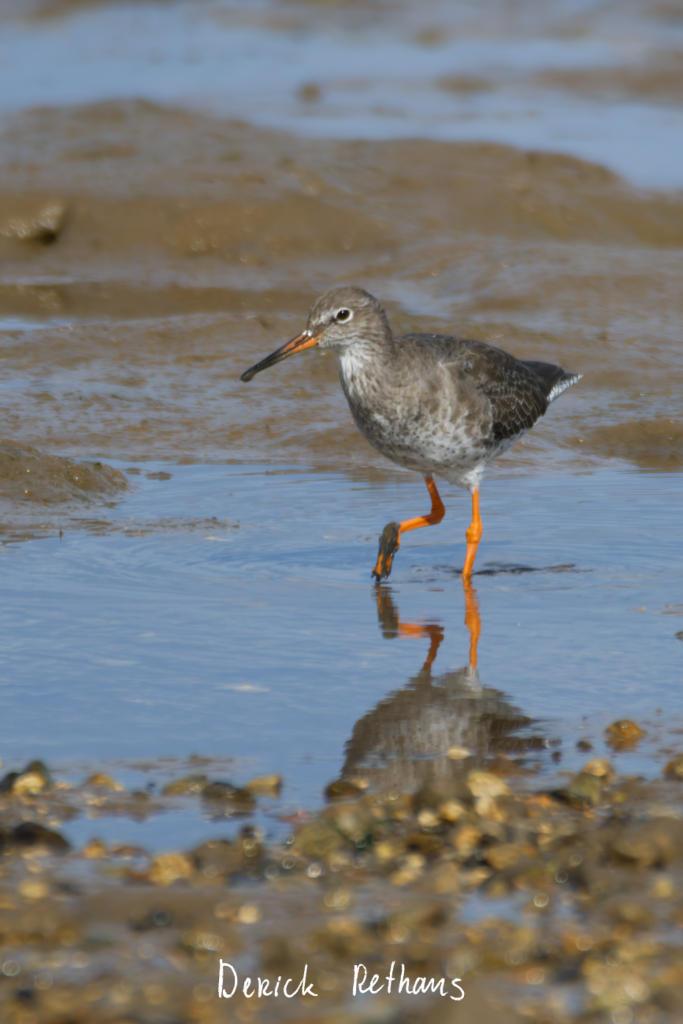
Redshank Strolling On The Mud
This lovely bird was mooching about white close by on the mudflat at Brancaster Staithe. Picking through the puddles and mud to find something to eat.
#photography #Birds #BirdPhotography #BirdsOfFediverse #NaturePhotography #wildlife #Norfolk
Specify whether public transport stops have bins
Determine whether amenities are inside buildings
Specify whether public transport stops have tactile paving
Determine place names
Survey if vacant places are still vacant
Survey if places still exist
Determine roads lane count
Specify whether there are crossings at intersections of paths and roads
Survey tactile paving on steps
Specify whether steps have a ramp
Specify which way leads up for steps
Specify whether steps have handrails
Survey if places still exist
Specify cycle barrier installation
Specify cycle barrier types
Specify whether roads have lane markings
Specify whether there are cycleways
Specify bollard types
Specify width of opening
Specify path surfaces
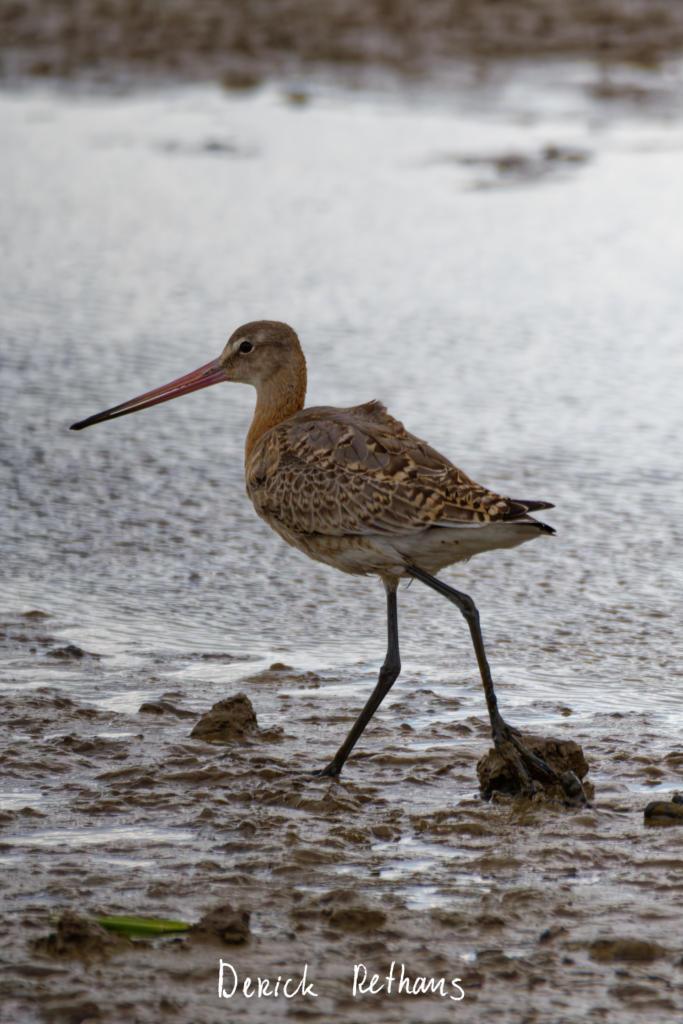
Black-tailed Godwit Smooching About
At RSPB Titchwell Marsh, there are many different habitats. This one has many muddy flats, and different species.
This bird was being chased by a fellow bird, and landed almost straight in front of the hide, with the light just being right.
#photography #Birds #BirdPhotography #BirdsOfFediverse #NaturePhotography #wildlife #Norfolk #RSPB #TitchwellMarsh
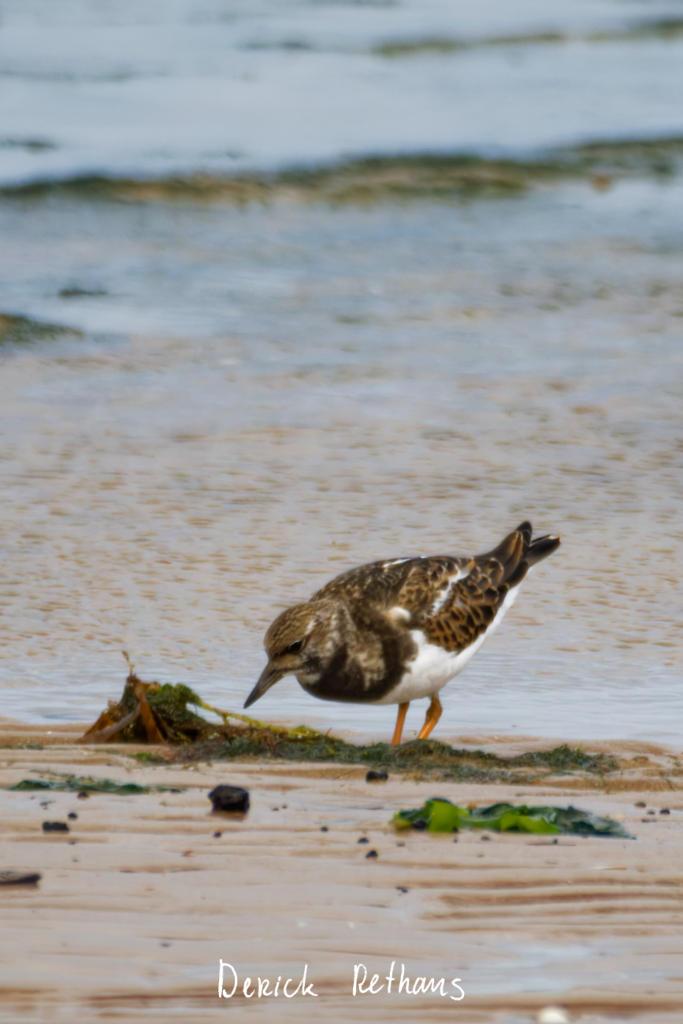
A Ruddy Turnstone Turning Over Stones On The Beach
A bunch of them were turning over things on Hunstanton Beach to see if there were any grubs to eat.
#photography #Birds #BirdPhotography #BirdsOfFediverse #NaturePhotography #wildlife #Norfolk
I've just donated blood again, for the first time in a while (for reasons). Now for the best thing, the free snacks!
Updated a restaurant and a pharmacy
Shortlink
This article has a short URL available: https://drck.me/postbox1-auc